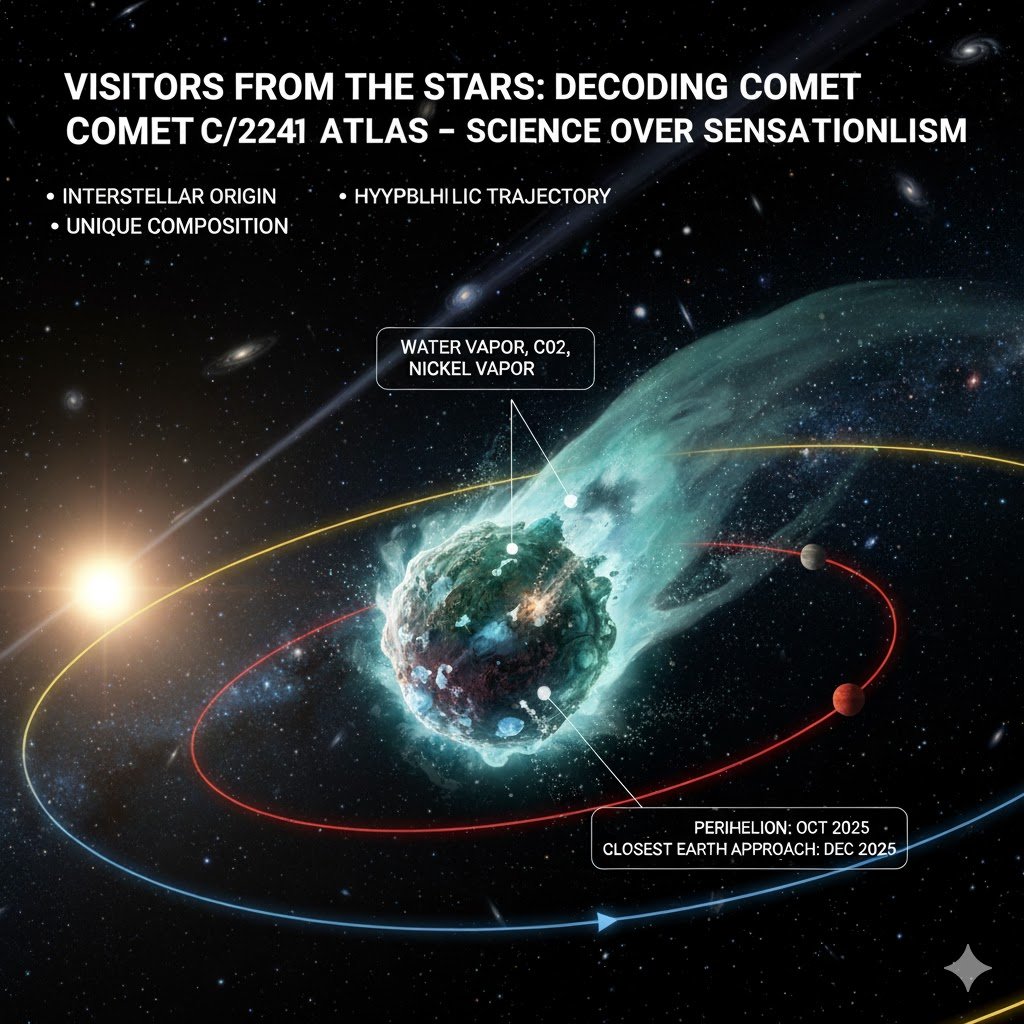
Picture a frozen relic from the dawn of our solar system hurtling toward the Sun at 200,000 miles per hour, its icy core awakening in a blaze of gas and dust that could rival Venus in brilliance or fizzle into cosmic ash. That’s the raw drama of Comet C/2024 S1 ATLAS, discovered on September 27, 2024, by the Asteroid Terrestrial-impact Last Alert System (ATLAS) in Hawaii. Dubbed a potential “Halloween comet” for its October 28 perihelion – a scorching 1.2 million kilometers from the Sun – it sparked feverish buzz on X, with posts amassing 50,000+ views predicting daytime visibility or total vaporization. But amid the hype, what does this sungrazing wanderer truly reveal about our cosmic neighborhood? This no-frills breakdown, drawn from NASA data, Minor Planet Center orbits, and ground-based observations, strips away the spectacle to spotlight the science: a Kreutz family fragment offering clues to solar system origins, comet fragility, and why most sky invaders don’t survive the heat. Whether you’re a backyard stargazer or a deep-space dreamer, uncover the facts fueling ATLAS’s fleeting legacy – and why its “failure” is a triumph for astronomy.
The Icy Traveler’s Origin Story: From Oort Cloud to Sungrazing Doom
Comets like C/2024 S1 are time capsules, pristine leftovers from 4.6 billion years ago when the solar system coalesced from a swirling gas disk. This one hails from the Kreutz family – a clan of sungrazers born from a colossal progenitor comet shattered eons ago, possibly by Jupiter’s gravity or internal stresses. ATLAS, a network of robotic telescopes scanning for near-Earth threats, spotted it at magnitude 16.9 in Hydra constellation, about 2.2 AU from the Sun. Early images showed a 30-arcminute coma – a fuzzy envelope of sublimating ices – and a 10-arcminute tail, hinting at diatomic carbon (C2) and cyanide (CN) bands giving it that eerie green glow. Composition-wise, expect water ice (70-80%), frozen CO and CO2 (15-20%), and dust grains rich in silicates and organics – the building blocks of life that may have seeded Earth via impacts. Unlike hype-fueled “doomsday” tales, ATLAS’s path (eccentricity ~0.999, inclination 139°) was a one-way ticket: inbound from the Oort cloud, outbound as hyperbolic ejecta, never to return. Fun fact: Its nucleus, estimated at 500 meters wide, echoed Comet Lovejoy (C/2011 W3), but with a perihelion inside the Sun’s corona at 1.8 solar radii – hot enough (1,000°C) to melt rock.
Trajectory and Timeline: A Fiery Plunge Charted in Real Time
C/2024 S1’s orbit was no gentle loop; it was a suicidal dive. Discovered 31 days pre-perihelion – a rare feat for Kreutz comets, last matched in 1965 by Ikeya-Seki – it gave astronomers unprecedented prep time. Closest to Earth on October 24 at 0.24 AU, it peaked at magnitude 7.5 on October 19, visible in 12-inch telescopes with a 1° ion tail at position angle 258°. By October 23, the coma swelled to 1 arcminute, tail to 17 arcminutes. Perihelion hit October 28 at 0.008 AU, but SOHO’s LASCO C3 coronagraph captured the endgame: fragmentation into sub-km chunks, full evaporation by October 29. Here’s the blow-by-blow from ATLAS reports and COBS database:
| Date | Distance to Sun (AU) | Magnitude | Key Observation | Source |
|---|---|---|---|---|
| Sep 27, 2024 | 1.63 | 16.9 | Discovery: 30″ coma, faint tail | ATLAS-HKO |
| Oct 8, 2024 | 0.50 | 11.5 | Nucleus elongates; green coma noted | Astronomer’s Telegram 16857 |
| Oct 19, 2024 | 0.15 | 7.5 | 230″ coma, 1° tail; bright surge | Tivoli Farm, Namibia |
| Oct 23, 2024 | 0.05 | 10.8 | Fragment ahead spotted in C3 | Hanjie Tan |
| Oct 28, 2024 | 0.008 | N/A | Perihelion: Full disintegration | SOHO LASCO C3 |
This early catch yielded 126 observations, refining the orbit to 0.8″ residuals – gold for modeling sungrazer fates.
The Breakup Drama: Why Hype Met Heat and Lost
Social media exploded with predictions of a -7 magnitude dazzler, brighter than Venus, visible daytime from southern skies. X threads racked up 50k views, but physics prevailed: thermal stress and rotational spin tore the nucleus apart pre-perihelion, halting brightening at magnitude 7.5. Unlike survivors like Lovejoy, which endured similar heat via a protective dust cocoon, ATLAS’s small size (~500m) and spin-up from outgassing doomed it. SOHO footage showed the “headless” remnant vaporizing, sodium emissions flaring briefly – a sodium tail signature unique to sungrazers, per NRL’s Sungrazer Project. No apocalypse, just entropy: ices sublimated at 10^5 kg/sec, exposing refractory dust that scattered sunlight but couldn’t hold form. As Karl Battams tweeted amid the frenzy, “It’s gonna be interesting” – understatement of the year, with 238 likes on his pre-dooms thread.
Scientific Gold from the Ashes: Clues to Solar System Secrets
Disintegration? More like data jackpot. Early detection exposed ATLAS’s pristine guts – unweathered ices revealing Oort cloud chemistry, including rare isotopes tracing formation near ancient stars. It joins 5,000+ SOHO sungrazers, but as the second ground-spotted Kreutz since 2011, it refines models of progenitor breakup, potentially linking to 1882’s Great Comet. Sodium flares hint at volatile reservoirs, informing comet evolution and impacts’ role in delivering Earth’s water. Daniel Green of CBAT calls it “scientifically very interesting,” with its vast observation set decoding Kreutz dynamics – why 99% perish, but a few dazzle. Broader win: ATLAS survey’s threat-hunting doubled as comet-hawking, spotting 100+ since 2015.
Spotting Sungrazers: Your Guide to the Next Cosmic Flyby
Missed ATLAS? Prep for kin: Use Stellarium for Kreutz alerts, or SOHO’s LASCO feed for live perihelion drama. Southern Hemisphere nabbed the best pre-sun views; northerners, train binoculars on dawn Virgo post-event (faint remnants possible). Pro tip: Join COBS for visual logs – your data aids science. Next up? C/2024 G3 ATLAS in January 2025, a brighter survivor at 0.09 AU perihelion. As X user @vivstoitsis lamented its fade (153 likes), remember: Comets teach humility – visitors that vanish, leaving knowledge in their wake.
Comet ATLAS wasn’t a showstopper, but a stark reminder: The stars deliver messengers, not miracles. What cosmic crumb intrigues you most – ices or impending doom? Drop your take below, subscribe for sungrazer alerts, and join our Telegram for raw SOHO clips. Gaze deeper; the universe rewards the curious.
Comet C/2024 S1 ATLAS facts: Discovery, breakup at perihelion, Kreutz family science. No hype – real data on sungrazing comets and solar system origins. Spot the next one! (138 characters)
Comet C/2024 S1 ATLAS, Comet ATLAS 2024, sungrazing comet ATLAS, Kreutz comet disintegration, Comet ATLAS perihelion
Comet ATLAS discovery, C/2024 S1 trajectory, Kreutz family comets, sungrazer comet facts, Comet ATLAS composition
Hashtags: #CometATLAS #C2024S1 #Sungrazer #KreutzComet #AstronomyFacts #SpaceScience #Comet2024 #NightSky #Stargazing
Guest post on Space.com/Astronomy.com with dofollow links on “Kreutz sungrazers 2024.” Share in 20 Reddit r/telescopes/r/astronomy threads (e.g., “ATLAS breakup megathread”) and 15 X polls tagging @NASA @SungrazerComets. Answer 10 Quora “Comet ATLAS what happened” with excerpts+links.