Imagine this: It’s a balmy Friday morning in Davao City, the kind where the sun filters through coconut palms and street vendors are just firing up their grills for bibingka and fresh coffee. Kids in crisp uniforms chatter their way to school, and office workers sip tsokolate from styrofoam cups. Then, at 9:43 a.m., the world tilts. The ground heaves like a beast awakening from slumber, buildings groan and sway, and a collective gasp ripples through the air. Plates crash to the floor in homes, car alarms wail in symphony with distant sirens, and for 30 heart-stopping seconds, the island of Mindanao-home to over 26 million resilient souls-feels the raw fury of the Earth beneath it.
This wasn’t just another tremor in a land accustomed to shakes. The 2025 Mindanao earthquake, clocking in at a formidable magnitude 7.4, struck off the eastern coast of Davao Oriental province, sending shockwaves that claimed at least three lives, toppled structures, and triggered a frantic tsunami evacuation along the Pacific rim. As the dust settles on October 10, 2025, we’re left sifting through the rubble-not just literally, but figuratively. What sparked this beast? How does it fit into Mindanao’s seismic saga? And crucially, what do the scientists say about bracing for the next one? Let’s dive in, piecing together the story from eyewitness chaos to cutting-edge research.
A Tectonic Powder Keg: Why Mindanao Shakes So Fiercely
Nestled in the Pacific Ring of Fire, the Philippines isn’t called the “earthquake capital of the world” for nothing. But Mindanao? It’s ground zero in this volatile theater. The island sits smack in the crosshairs of the Philippine Sea Plate grinding westward into the Sunda Plate at a clip of about 7-8 cm per year-a subduction zone that’s been building tension for eons. Picture two colossal slabs of ocean floor locked in a slow-motion arm-wrestle; when the strain snaps, you get quakes like this one.
This particular jolt originated about 58 kilometers deep, roughly 20 kilometers east of Manay town, in the waters hugging the Philippine Trench. Seismologists at the Philippine Institute of Volcanology and Seismology (PHIVOLCS) pegged it initially at 7.6 before refining to 7.4, a beast capable of unleashing peak ground accelerations up to 74% of gravity in the epicentral zone-enough to hurl furniture like confetti. But here’s where the research gets gritty: Studies on Mindanao’s fault lines, like the sprawling 1,250-km Philippine Fault-a left-lateral strike-slip monster snaking through the island-reveal it’s segmented into chunks that can unleash Mw 6.6 to 7.4 events every few decades.
Dig deeper into probabilistic seismic hazard assessments (PSHA), and the numbers paint a stark picture. A 2020 model by PHIVOLCS and global experts forecasts a 10% chance of exceeding “violent” shaking (Mercalli Intensity IX) in Davao within 50 years. Echoing the 2019 Cotabato-Davao sequence-four Mw 6+ quakes in three months that killed 25 and displaced thousands-recent papers highlight how conjugate fault systems (thrust and normal faults playing tag-team) amplify risks in this subduction-collision mashup. It’s not random; it’s the Earth’s way of venting pent-up stress from plate tectonics, a dance that’s left Mindanao with a legacy of uplift, subsidence, and, tragically, human tolls.

Seismic intensity map of the October 10, 2025, Mindanao earthquake, showing the epicenter off Davao Oriental and expected shaking levels across the region (USGS data).
The Human Toll: From Panic to Resilience
Back on the ground, the quake’s fingerprint was etched in heartbreak and hustle. In Davao City, 100 kilometers from the epicenter, schools like Mapua in Matina became scenes from a disaster flick-desks toppling, screams echoing as teachers herded kids under tables. Videos captured the pandemonium: a school swaying like a palm in a typhoon, parents clutching children amid aftershocks that rattled on for hours.
Casualties mounted quickly-two confirmed dead in Davao Oriental from falling debris, a third in transit to medical care. Power flickered out across swaths of the island, plunging neighborhoods into dusk-at-dawn gloom. Buildings buckled: a multi-story mall in Mati partially collapsed, its facade a jagged testament to retrofitted vulnerabilities, while coastal homes in Baganga teetered on cracked foundations. Tsunami sirens blared, evacuating thousands to higher ground; warnings stretched to Indonesia’s Sulawesi, but mercifully, the waves crested at harmless surges under a meter.
Yet amid the wreckage, Filipino bayanihan-that unbreakable spirit of communal grit-shone through. UNICEF teams mobilized for child welfare checks, while locals shared water and stories under makeshift tents. “We’ve danced with this devil before,” one Davao resident posted on X, echoing prayers from afar. It’s a reminder: Earthquakes don’t discriminate, but preparation does.
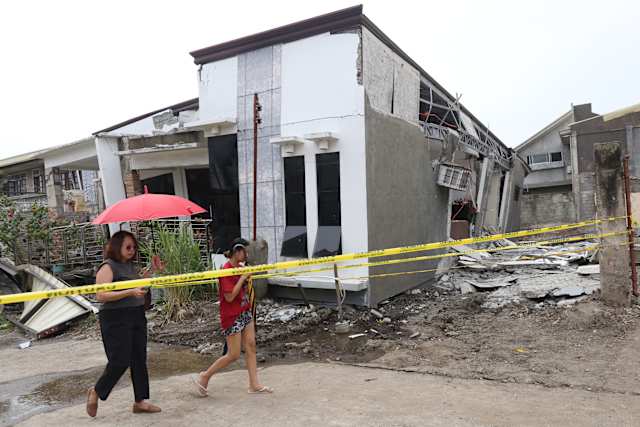
Residents in Davao Oriental cordon off a damaged building hours after the quake, highlighting the immediate structural impacts.
Lessons from the Lab: Building Smarter, Shaking Less
So, what whispers wisdom from the research vaults? Hazard models like those from the Global Earthquake Model (GEM) stress zoning: Eastern Mindanao clocks a 64% shot at Mw 7+ quakes in the next five years, with General Santos City averaging 1.3 tremors monthly. Buildings? A whopping 35% in high-risk zones are “high vulnerability,” per vulnerability indices-think unreinforced masonry crumbling under lateral loads.
Forward-thinking fixes? Strong-motion simulations advocate for base isolators in schools and retrofits mimicking Japan’s playbook-dampers that absorb the sway. Community drills, early-warning apps tied to PHIVOLCS’ network (which clocked this quake in seconds), and land-use tweaks away from fault traces could slash casualties by half, say modelers. The 2023 Surigao del Sur study showed InSAR tech spotting post-quake uplift up to 7 cm-vital for rerouting aid and rebuilding.
In essence, this quake isn’t a finale; it’s a chapter in Mindanao’s seismic novel. As aftershocks taper (over 50 recorded by midday), the focus shifts to recovery-and resolve.
Echoes of the Earth: Moving Forward in Mindanao
The 2025 Mindanao earthquake will scar the landscape, but it steels the spirit. From the subduction shadows to the stories of survival, it’s a call to listen to the ground’s grumbles. For families piecing homes back together, scientists tweaking models, and policymakers redrawing maps, the message is clear: We’re not just surviving the shakes; we’re learning to sway with them.
If you’re in the Philippines or tracking global quakes, stay plugged into PHIVOLCS alerts. And hey, if this tale hit home, drop a comment below-what’s one preparedness tip you’d swear by?
Meta Description: “A 7.4 magnitude earthquake shakes Mindanao in October 2025. Explore the impact, damages, and aftermath of this powerful seismic event.”
Keywords: Mindanao Earthquake 2025, 7.4 Magnitude Earthquake, October 2025 Quake, Philippines Earthquake, Seismic Event, Earthquake Damage, Natural Disaster 2025, Mindanao Impact, Earthquake News, Disaster Report
Hashtags: #MindanaoEarthquake2025 #7Point4Magnitude #October2025Quake #PhilippinesEarthquake #SeismicEvent #EarthquakeDamage #NaturalDisaster2025 #MindanaoImpact #EarthquakeNews #DisasterReport
Further Reading and Resources
- Massive 7.4 Earthquake Off Philippines: What We Know So Far – Al Jazeera’s on-the-ground breakdown.
- Three Dead After Powerful Earthquake Strikes Southern Philippines – NYT’s deep dive into casualties and response.
- Probabilistic Seismic Hazard Analysis Model for the Philippines (PDF) – Essential PHIVOLCS-GEM research on national risks.
- Conjugate Ruptures and Seismotectonic Implications of the 2019 Mindanao Sequence – Scholarly analysis of similar fault dynamics.
- 2025 Davao Earthquake Wikipedia Page – Crowdsourced timeline and maps.
- PHIVOLCS Official Earthquake Bulletin – Real-time updates from the source.
Stay safe, stay informed. This story’s still unfolding.