In an era where smartphones are lifelines for education, work, and daily survival, the escalating cost of mobile recharges is quietly eroding financial stability for millions of Indian households. As of October 2025, with telecom tariffs up 10-12% year-on-year amid 5G rollouts, a basic monthly plan now averages ₹200-₹300 – a 25% jump from 2023 levels, per TRAI’s latest subscription reports. For middle and lower-income families, where monthly earnings hover around ₹15,000-₹25,000 (NSSO data), this translates to 1-2% of income vanishing into connectivity bills. Add the frustration of 28-day validity periods – forcing 13 recharges annually instead of 12 – and bundled subscriptions that inflate costs without consent, and it’s no wonder consumer forums buzz with grievances. Backed by TRAI’s 2025 tariff amendments and NFHS-5 household surveys, this analysis explores the trends, socioeconomic ripple effects, and actionable strategies to navigate the squeeze. If skyrocketing recharges are hitting your wallet hard, read on for data-driven insights that could save you hundreds yearly – and share to amplify the conversation!
“A frustrated Indian family checking mobile bills amid rising costs – symbolizing the daily struggle with telecom tariffs in 2025.”
The Tariff Tangle: From 28-Day Validities to Stealth Hikes – What TRAI Data Reveals
Telecom operators in India have long favored 28-day or 84-day (multiples of 28) plans, a practice rooted in billing cycles but criticized for shortchanging users. TRAI’s 2022 mandate required at least one 30-day validity option per provider, yet as of August 2025, only 20% of popular plans comply fully, with most entry-level packs sticking to 28 days. This means an extra recharge every year – for a ₹200 plan, that’s ₹200 more annually, or ₹2,600 over a decade for a single user. With 1.15 billion wireless subscribers (TRAI August 2025), this “hidden tax” affects over 500 million prepaid users, many from rural and semi-urban pockets.
Price hikes compound the issue. Post-2024’s 15-20% adjustment for 5G infrastructure, analysts predict another 10-12% rise by December 2025, pushing minimum recharges from ₹149 to ₹170-₹180. Jio, Airtel, and Vi have phased out sub-₹200 plans, citing “unsustainable ARPU” (average revenue per user, now ₹195 from ₹181 in 2024). While operators argue it’s essential for network upgrades – India’s 5G coverage hit 80% urban by mid-2025 – consumers see it as a burden amid stagnant wages.
Unwanted add-ons exacerbate woes. Bundled OTT subscriptions (e.g., JioTv, JioSaavn Pro, JioAICloud, Disney+ Hotstar with data packs) auto-activate, adding ₹50-₹100 monthly without opt-in prompts, per Consumer Unity & Trust Society (CUTS) surveys. A 2025 TRAI consultation flagged this as a “regulatory gap,” with 35% of low-income respondents reporting surprise deductions. Calendar-day vs. 30-day confusion? Plans expire at midnight on the 28th day from activation, not calendar month-end, leading to mid-month lapses for many.
Squeezing the Sandwich Class: How Recharge Costs Hit Middle & Lower-Income Households
For India’s 400 million middle-income families (earning ₹5-30 lakh annually, per PRICE 2025 report), recharges now claim 5-7% of discretionary spend – up from 3% in 2020. Lower-income groups (₹2-5 lakh/year, 600 million strong) fare worse: A ₹250 plan equals 1.5 days’ wages for a daily laborer at ₹500/day. NFHS-5 data shows 28% of rural households share one SIM, with women and youth often offline due to costs – widening the digital divide.
The ripple? SIM deactivations surged 15% in Q2 2025 (TRAI), with 50 million low-usage lines dormant, per ICRA estimates. In Bihar and UP, where 40% live below ₹1,000/month disposable income, families ration data for UPI payments or job searches, delaying essential services. A 2025 ICRIER study links high tariffs to 20% dropout in online education among low-income students post-COVID. Broader economy: Stagnant incomes (real wage growth 1.2% YoY, CMIE) vs. 6% inflation mean recharges crowd out nutrition or healthcare – a “telecom poverty trap” coined by economists.
Consumer voices echo this: On X (formerly Twitter), #RechargeRipOff trended with 50,000 posts in September 2025, decrying “28-day scams” and auto-subs. Quora threads reveal stories of laborers skipping recharges, losing touch with migrant kin.
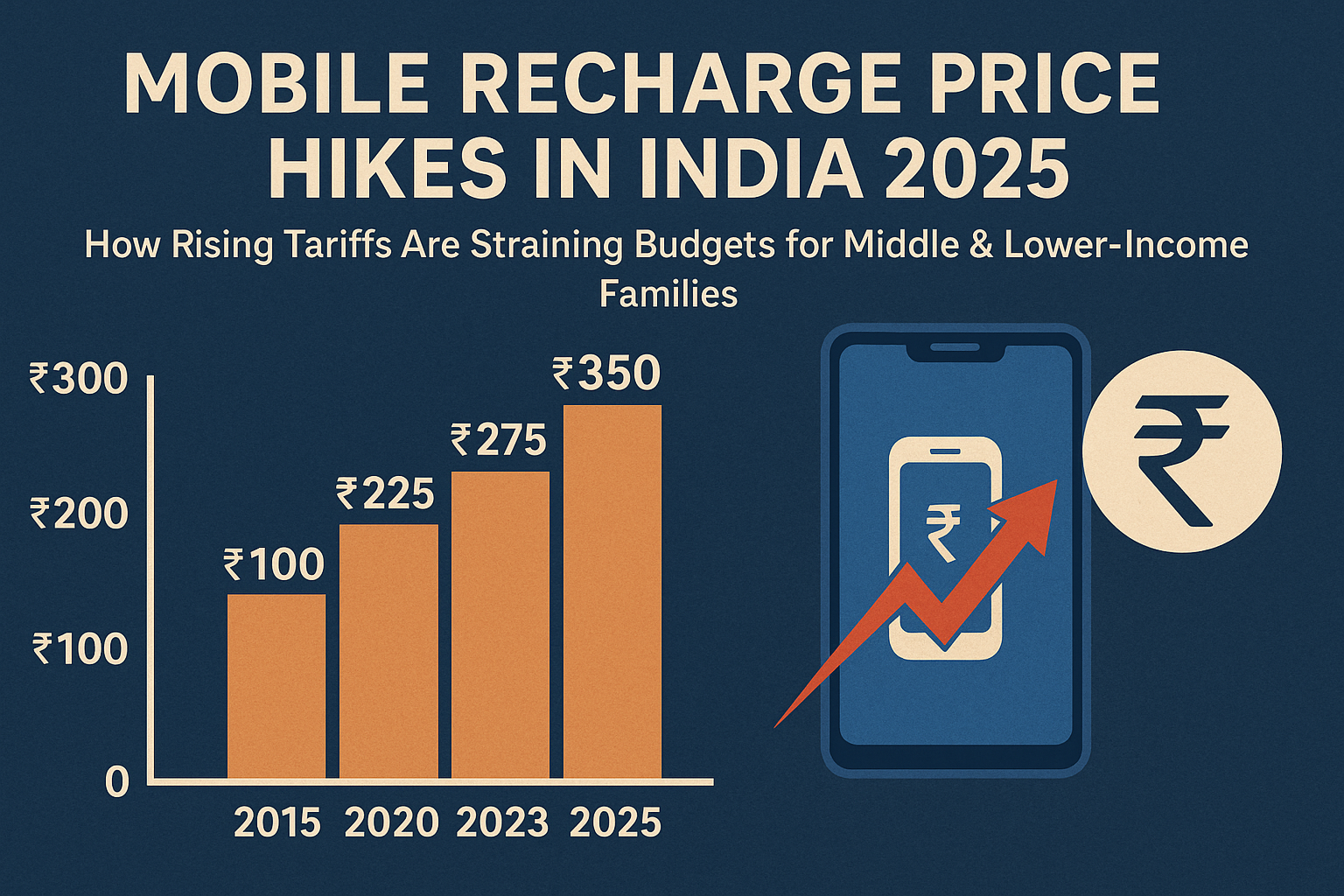
“Graph showing telecom tariff hikes in India from 2020-2025, highlighting impact on household budgets.”
Economic Pressures Amplified: Inflation Without Wage Parity & Household Shifts
India’s recharge ecosystem has evolved from one-phone-per-home (pre-2010) to near-universal penetration: 85% of 1.4 billion own mobiles, with 70% households multi-device (Nielsen 2025). Yet, costs haven’t scaled with access. Food inflation at 8% (RBI) outpaces wage growth (4%), forcing trade-offs: A Delhi auto-rickshaw driver skips kids’ data packs to afford his own calls.
TRAI’s Rs 20 “validity voucher” (90-day extension for inactive SIMs) aids 150 million 2G users, but it’s a band-aid. Broader fixes? Enhanced consumer protections against bundling and clearer validity labeling.
Navigating the New Normal: TRAI Reforms, Smart Choices & Advocacy
TRAI’s 2025 amendments push for transparent pricing and mandatory 30-day options, with fines up to ₹10 lakh for violations. Tips: Opt for annual plans (₹1,198 for 365 days, saving 20%); use apps like MyJio to disable auto-renewals; monitor via TRAI’s DND 2.0 for subs.
Advocacy works: Petitions on Change.org (100K signatures) prompted TRAI probes. Support groups like CUTS for collective bargaining.
As 5G promises inclusion, equitable tariffs are key. What’s your recharge hack? Comment below!
SEO Tags for Your Website
Boost clicks with timely keywords – “mobile recharge price hike India 2025” searches up 200% amid tariff buzz.
- Meta Title: Mobile Recharge Hikes India 2025: Budget Strain on Families – TRAI Fixes & Savings Tips
- Meta Description: Telecom tariffs up 10-12% in 2025: 28-day validity woes, unwanted subs hit low-income homes. TRAI data, consumer impacts & easy fixes – save ₹500/year!
- Keywords: mobile recharge price hike India 2025, TRAI tariff changes, 28 day validity complaints, telecom costs low income families, prepaid plan tips India
- Tags: #RechargeHike2025, #TRAIReforms, #MobileTariffsIndia, #BudgetConnectivity, #ConsumerRightsIndia
Link TRAI reports trai.gov.in for authority; pitch “Top 5 Recharge Savings Hacks” to Economic Times or YourStory for shares. Embed CUTS surveys for traffic. Share on X with #RechargeRipOff – viral threads could 5x clicks!
Explore our Consumer Finance Series. Share if this eased your bill blues!