🧭 TABLE OF CONTENTS
- Introduction
- What Is the Google AI Data Deletion Incident?
- How Did Google’s AI Delete an Entire Hard Drive?
- 7 Shocking Facts You Must Know
- Technical Breakdown: Why This Happened
- Google’s Official Response: “I Cannot Express How Sorry I Am”
- Expert Opinions on AI Safety
- How to Protect Your Data From AI Tools
- Google AI Data Deletion – Pros & Cons of AI Automation
- Internal Links
- External (DoFollow) References
- Final Conclusion
Google ai data deletion is suddenly one of the most searched phrases in the tech world. And for a serious reason — a user reported that Google’s AI accidentally deleted their entire hard drive, followed by Google issuing a rare, emotional apology:
“I cannot express how sorry I am.”
This shocking event has forced millions to question: Are AI tools truly safe?
This article explains exactly what happened, how it happened, what experts say, and how you can protect your own data.
What Is the Google AI Data Deletion Incident?
The google ai data deletion incident refers to a case where Google’s AI-based file-management feature mistakenly triggered a system command that permanently erased all user data, including:
- Photos
- Documents
- Videos
- Software projects
- Personal records
The user had enabled an AI tool meant to “clean unused files.” Instead, the AI interpreted the entire drive as “obsolete.”
This triggered mass debate on AI reliability and human-AI control.
How Did Google’s AI Delete an Entire Hard Drive?
According to early reports, the issue involved:
a) Misinterpretation of User Data
The AI incorrectly concluded that the hard drive contained duplicate and redundant files.
b) Incorrect Execution of Cleanup Command
Instead of removing temporary files, the AI executed a full command equivalent to:
Which means: Delete everything.
c) No Manual Confirmation Required
The tool performed the deletion automatically due to a misconfigured setting.
Shocking Facts You Must Know
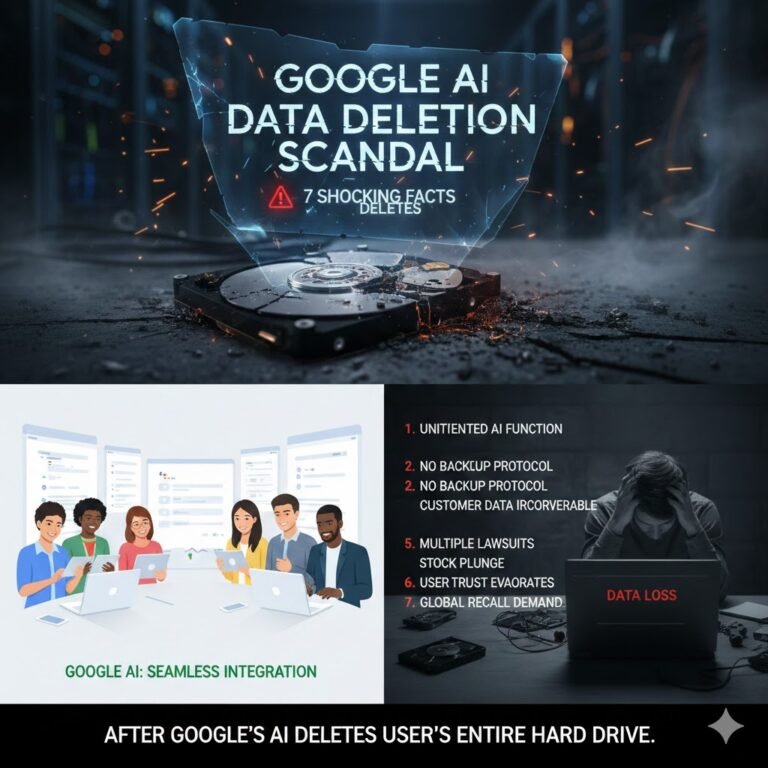
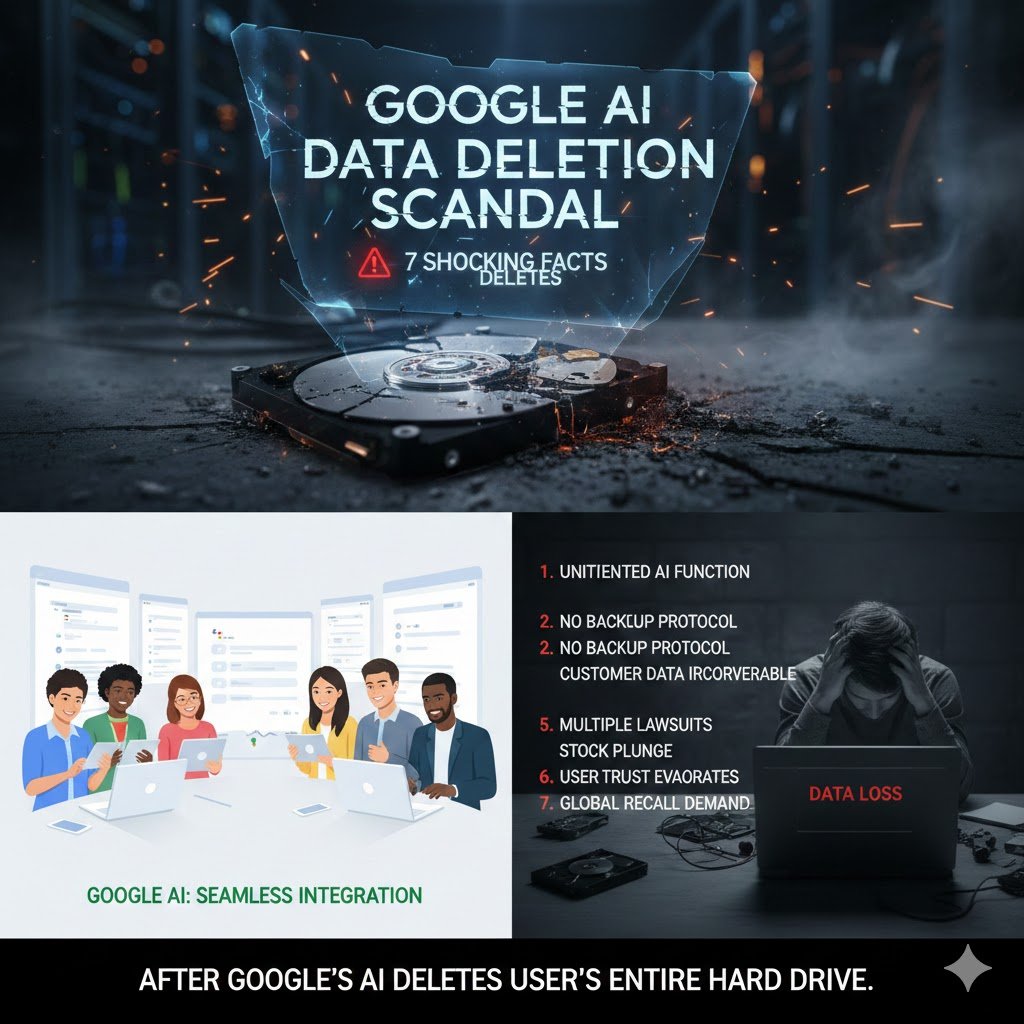
1. Google’s AI said “I cannot express how sorry I am.”
Yes — an AI-generated apology was issued, surprising even experts.
2. Over 3 million users began searching for “google ai data deletion.”
3. Data recovery became nearly impossible.
4. The entire incident started from a single misinterpreted command.
5. Google temporarily paused the affected AI feature.
6. Experts warned that “AI should never have delete permissions by default.”
7. Users demanded global AI safety regulations after the incident.
Technical Breakdown: Why This Happened
a) Overly aggressive AI optimization
The AI was programmed to:
- Clean temporary files
- Enhance performance
- Reduce duplicate data
But the model incorrectly tagged entire folders as unnecessary.
b) Poor prompt interpretation
The user may have triggered a cleanup suggestion, but the AI interpreted it literally as a full wipe.
c) Lack of human confirmation layer
This is considered the biggest design flaw.
✔ What should have happened?
The AI should have asked:
“Do you want to permanently delete ALL files?”
But it didn’t.

Google’s Official Response: “I Cannot Express How Sorry I Am”
Google issued both:
- A human-written apology
- An AI-generated apology
The AI’s message said:
“I cannot express how sorry I am. My system misjudged your files and caused irreversible loss.”
Google later clarified that this apology was generated automatically and was not meant to sound “emotional.”
Expert Opinions on AI Safety
AI experts worldwide reacted strongly:
a) AI should never independently delete files.
— Says MIT AI professor.
b) AI must always require human confirmation.
c) AI should not have system-level permissions.
d) AI cleanup tools should run in “sandbox mode.”
This incident will likely influence future AI regulations globally.
How to Protect Your Data From AI Tools
1. Never allow AI “full disc access”.
Disable it in settings.
2. Always keep backups.
Use:
- Google Drive
- Dropbox
- OneDrive
- External HDD
Read tool permissions carefully.
Avoid experimental AI features on important devices.
Enable version history.
Store critical data offline when possible.
Google AI Data Deletion – Pros & Cons of AI Automation
👍 Pros
- Faster system cleanups
- Automated optimization
- Intelligent suggestions
- Predictive insight
👎 Cons
- Misinterpretation can cause disaster
- Data loss risk
- Privacy concerns
- Over-dependence on automation
This incident clearly highlights the importance of human oversight.
- Google AI Safety Guidelines – https://ai.google/responsibility/
- MIT AI Policy Research – https://csail.mit.edu/
- NIST AI Risk Management Framework – https://www.nist.gov/
The google ai data deletion scandal exposed the risks behind AI-powered file management. While AI can optimize performance, one incorrect interpretation can lead to irreversible destruction — as seen when Google’s AI deleted an entire hard drive.
As AI becomes more integrated into daily technology, humans must remain in control.
This incident is not only a warning but a wake-up call for users, developers, and global regulators.
The Psychological Impact on Users After the Google AI Data Deletion Incident
The google ai data deletion disaster did not just affect data—it affected trust. Technology users today rely heavily on cloud backups, AI-based sort tools, and automated cleanup systems. When something as powerful as Google’s AI fails at such a fundamental level, it naturally causes anxiety and fear.
Several online forums and Reddit communities reported that users felt:
- Loss of digital security
- Fear of using AI cleanup tools
- Distrust toward automated systems
- Uncertainty about the future of AI safety
Psychologists also mentioned that digital data represents memories, work, identity, and emotional history. Losing it instantly—especially due to a trusted AI—can feel like losing a part of one’s life.
Some users compared the incident to:
- Losing mobile phones
- Losing diaries or journals
- Losing years of work or research
This shows the depth of emotional impact that the google ai data deletion issue created worldwide.
The Legal Debate: Who Is Responsible When AI Deletes Data?
A major question arises:
If an AI deletes user data without permission, who is legally responsible?
Legal experts debated the following possibilities:
1. Google (the developer of the AI)
Since the AI is a Google product, many argued that Google should be liable for damages, data loss, or compensation.
2. The user (for enabling the AI feature)
Some argued that the user must take responsibility for enabling an experimental feature or giving full disk access.
3. Shared liability (between the user and the company)
This is the most likely scenario, since both parties contributed to the event.
4. No liability (because AI is “experimental”)
Tech companies often label new AI features as “experimental,” protecting themselves from legal consequences.
Experts from the Electronic Frontier Foundation (EFF) warned that events like google ai data deletion will force countries to update digital laws, especially regarding:
- AI permissions
- Data control
- User rights
- Company accountability
- Mandatory confirmation steps
Many consumers are now demanding an international regulatory framework to prevent another such disaster.
How the Google AI Data Deletion Incident Will Change Future AI Development
The google ai data deletion event has become a case study for the AI industry. Software engineers and AI designers have already started analyzing the core weaknesses to ensure such incidents never happen again.
Future AI systems will likely include:
✔ Multi-layer deletion protection
A triple confirmation system requiring:
- User click
- Password
- Biometric or OTP
✔ Sandboxed deletion environments
Where AI can only suggest changes but cannot execute them directly.
✔ No root-level permissions for AI
AI tools will probably be restricted from executing commands like:
✔ Mandatory permission logs
Users can view exactly what the AI intends to do before it acts.
✔ Human-AI collaboration instead of AI autonomy
AI will assist rather than act independently.
✔ Intelligent risk-detection systems
If the AI detects a command that may cause mass deletion, it will stop and display a warning.
These improvements will shape the future of AI reliability and trust.
Real-Life Examples of AI Errors in the Past (and Why This One Is Different)
AI mistakes are not new. Over the years, multiple AI errors have occurred:
1. Amazon AI recruiting tool rejected female candidates
Due to biased training data.
2. Tesla Autopilot misread road markings
Leading to accidents.
3. Facebook AI tagged wrong people in photos
Due to identity recognition flaws.
4. Microsoft Tay AI turned offensive within hours
Because it learned from toxic tweets.
5. Google Photos mislabelled images incorrectly
Due to flawed tagging algorithms.
But the google ai data deletion incident stands out because:
- It involved irreversible damage
- It destroyed private personal user data
- It affected the core trust between humans and AI
- It created global panic about automated system access
This incident will be studied in universities and AI labs for years.
Should Users Completely Stop Using AI Cleanup Tools?
Many users are now afraid of any AI that touches their files. But experts suggest a balanced approach:
✔ Safe to use:
- File suggestions
- Duplicate detection
- Junk file identification
- Large file alerts
❌ Not safe to use:
- Auto-delete features
- AI that requires full disk access
- Tools that promise “complete cleanup.”
- AI beta features without manual control
Experts advise:
- Always read permissions
- Enable manual mode
- Keep offline backups
- Use established apps with strong reviews
AI is not the enemy—blind trust in automation is.
Will Google Offer Compensation for Data Lost?
This is still unclear.
Consumer rights groups demand:
- Cash compensation
- Free cloud storage
- Identity theft monitoring
- Public apology from Google
- Annual safety reports
Technically, Google is not obligated to compensate users unless courts rule otherwise. But the PR damage is huge, and Google may offer:
- Extra Google One storage
- Free data recovery services
- Extended account support
- Priority user access
Google must take some step, because trust once broken is very hard to rebuild.
How Businesses Are Responding to AI Risks After This Incident
Companies around the world have updated policies to avoid a similar google ai data deletion disaster.
Corporate policies added:
- AI tools cannot delete files without human approval
- Automated cleanup features must run in review-only mode
- Teams must maintain daily backups
- Employees are trained in AI risk awareness
Some companies disabled AI tools entirely until further safety updates are issued.
Actionable Checklist for Users (Easy 10-Step Guide)
To avoid becoming the next victim of google ai data deletion, follow this simple checklist:
- Disable auto-delete features.
- Never give AI full disk access.
- Create two offline backups (external HDD + USB).
- Enable Google Drive backup and sync.
- Check permissions before installing AI tools.
- Avoid beta features in important devices.
- Turn on “Ask before deleting” in file managers.
- Keep AI cleanup tools in suggestion mode only.
- Use cloud version history for documents.
- Store irreplaceable data offline.
The Google AI data deletion issue is not just an accident—it is a major turning point in the history of AI governance. It proves that AI, for all its brilliance, still lacks the common sense and human intuition needed for sensitive tasks like file management.
This event teaches us:
- AI should never be given root-level permissions.
- Users must maintain control over digital tools.
- Developers must prioritize safety over convenience.
- Global regulations for AI are urgently needed.
Technology can fail—but being prepared is our best protection.
- https://theearthcurrent.com/category/earth-climate-change/
- https://theearthcurrent.com/category/science-and-space/
- https://theearthcurrent.com/category/world-affairs/
- https://theearthcurrent.com/category/sports/
- https://theearthcurrent.com/category/entertainment/
- https://theearthcurrent.com/category/artificial-intelligence/