In an era where artificial intelligence is reshaping industries and daily life, understanding its trajectory offers invaluable insights. From humble beginnings in data processing to today’s generative marvels, AI has evolved dramatically over the past two decades. As we stand in 2025, with AI boosting productivity across sectors, the next 10 years promise even more transformative advancements. This article explores AI’s journey, backed by research from leading reports and timelines, to highlight key milestones, current applications, and future trends that could redefine our world.

A visual timeline capturing key AI milestones from the past decades.
The Past 20 Years: Milestones That Built Modern AI (2005-2025)
The last two decades have seen AI transition from niche research to mainstream technology, driven by breakthroughs in machine learning, data availability, and computing power. Here’s a chronological breakdown of pivotal moments:
- 2005-2010: Foundations of Practical AI Around 2006, the resurgence of neural networks and deep learning began, fueled by increased computational capabilities. In 2011, IBM’s Watson won Jeopardy!, demonstrating AI’s ability to process natural language and vast knowledge bases. This period also saw the launch of Siri in 2011, integrating voice recognition into consumer devices.
- 2011-2015: Deep Learning Takes Center Stage The 2012 ImageNet competition marked a turning point when AlexNet, a convolutional neural network, drastically improved image recognition accuracy. By 2014, Eugene Goostman chatbot passed a version of the Turing Test, fooling judges into thinking it was human. Google’s DeepMind advanced with algorithms mastering Atari games in 2015, showcasing reinforcement learning.
- 2016-2020: AI Enters Everyday Life AlphaGo’s 2016 victory over Go champion Lee Sedol highlighted AI’s strategic prowess. The rise of autonomous vehicles accelerated, with companies like Waymo testing self-driving cars. By 2018, AI was powering recommendation systems on platforms like Netflix and Amazon, personalizing user experiences. The COVID-19 pandemic in 2020 amplified AI’s role in drug discovery and contact tracing.
- 2021-2025: Generative AI Explosion OpenAI’s GPT-3 in 2020 paved the way for ChatGPT’s 2022 launch, revolutionizing content creation and coding. By 2025, AI models like Grok and others have become more efficient, with open-weight models closing performance gaps to proprietary ones. Advancements in multimodal AI, combining text, image, and video, have expanded applications in creative industries.
These milestones illustrate AI’s shift from theoretical concepts to tools enhancing human capabilities, with investments surging from billions to trillions.
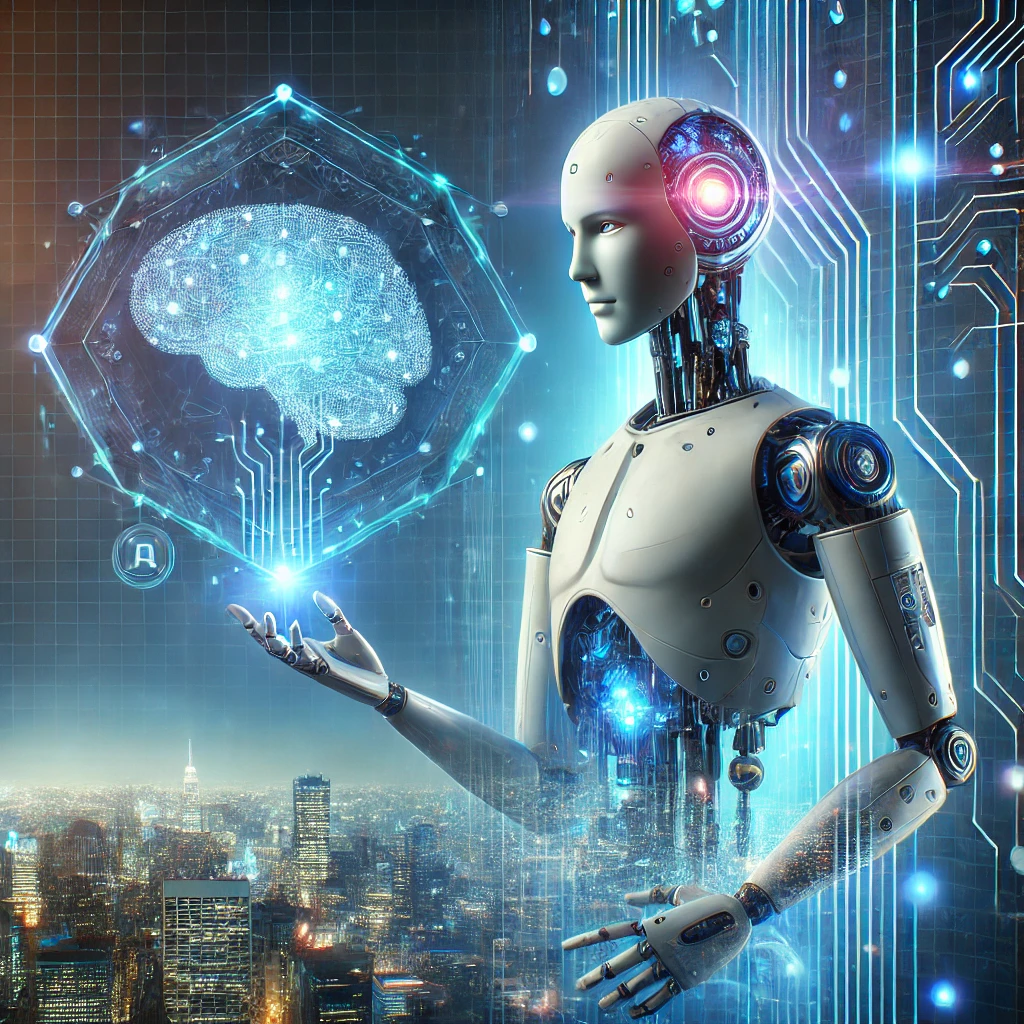
Illustration of current AI technologies, blending robotics and neural networks in 2025.
The Present State of AI in 2025: Advancements and Real-World Applications
As of 2025, AI is no longer futuristic—it’s integral to business and society. According to the Stanford AI Index, AI is boosting productivity and narrowing skill gaps in the workforce. Key advancements include more affordable and accessible models, with generative AI adoption in 50% of Australian businesses alone.
Current applications span diverse sectors:
- Healthcare: AI aids in diagnostics, personalized medicine, and robotic surgery, improving accuracy and efficiency.
- Finance: Fraud detection and algorithmic trading use AI to analyze patterns in real-time.
- Automation and Robotics: AI-powered agents handle complex tasks, from warehouse management to customer service.
- Creative Fields: Tools like AI image generators and content creators are turning consumers into producers.
Reports highlight AI’s role in driving bottom-line impact, with organizations investing in custom silicon and reasoning models. However, challenges like energy consumption and ethical integration persist, pushing for sustainable innovations.
The Future of AI: Predictions for the Next 10 Years (2025-2035)
Looking ahead, experts forecast AI’s integration into every facet of life, with growth at a 35.9% CAGR through 2030. By 2035, AI could exceed human intelligence in many domains, accelerating innovation cycles.
Key trends include:
- AI Agents and Autonomy: By 2027, 50% of enterprises may deploy autonomous AI agents for decision-making. These will handle predictive analytics and personalize experiences in real-time.
- Quantum and Advanced Computing: Integration with quantum tech could solve complex problems in drug discovery and climate modeling.
- Human-AI Collaboration: AI will augment jobs, creating new roles in oversight and creativity, while closing productivity gaps.
- Sustainable and Ethical AI: Focus on energy-efficient models and bias mitigation to ensure equitable benefits.
- Superhuman Capabilities: Predictions suggest AI impacting society more than the Industrial Revolution, with widespread adoption in education and entertainment.
By 2035, AI-driven economies could see exponential growth, with living intelligence accelerating stalled technologies.

Artistic vision of AI-integrated futurescapes by 2035.
Related News Links for Deeper Insights
Stay updated with these recent articles:
- Stanford’s 2025 AI Index Report – Comprehensive data on AI progress.
- McKinsey’s State of AI Survey – Business adoption trends.
- IBM’s Future of AI Insights – Predictions on analytics and decisions.
- PwC’s 2025 AI Predictions – Strategies for transformation.
- Keywords: Integrate “AI future 2035”, “AI history last 20 years”, “AI trends 2025-2035”, “artificial intelligence evolution”, “AI predictions next decade”.
- Meta Description: “Explore AI’s past 20 years, current innovations in 2025, and bold predictions for 2035. Discover how AI will transform your world—must-read insights!”
- Tags: #AIEvolution, #AIFuture2035, #AIHistory, #AITrends2025, #ArtificialIntelligence, #TechPredictions, #AIAdvancements.
Link to high-authority sites like the Stanford AI Index or Wikipedia timelines in your article. Collaborate with tech blogs for guest posts, share on social media for organic shares, and submit to directories like Reddit’s r/Futurology for exposure. Encourage readers to link back by offering embeddable infographics on AI timelines.
This engaging, visually rich article is designed to captivate readers, encouraging shares and visits to deepen their understanding of AI’s unstoppable march forward.