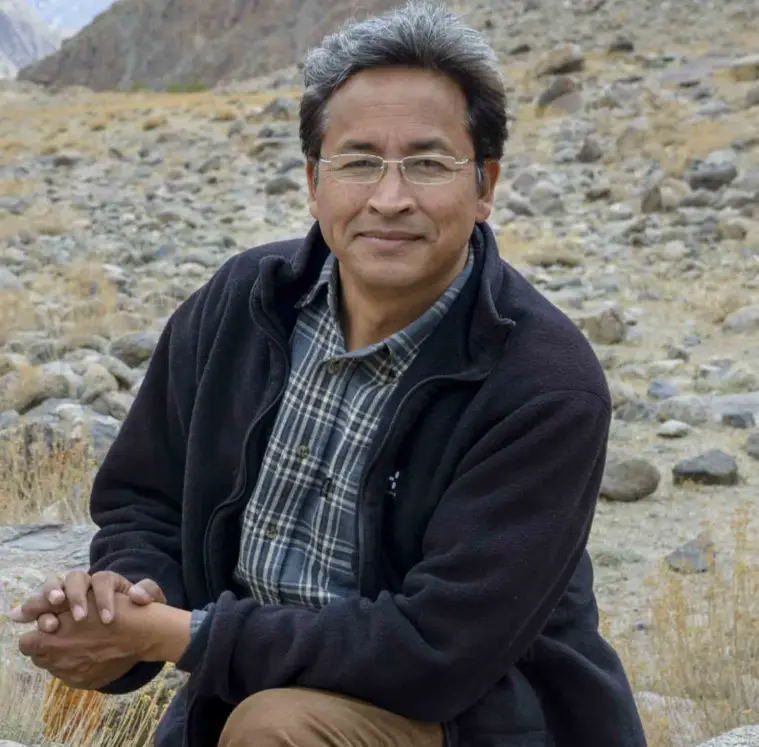
When we talk about grassroots innovation and sustainable development in India, the name Sonam Wangchuk shines brightly. Known as an engineer, educator, innovator, and environmentalist, Wangchuk has inspired millions with his practical solutions for real problems in the Himalayan region. His journey from a small village in Ladakh to becoming a globally respected innovator is nothing short of remarkable.
Early Life and Education
Sonam Wangchuk was born in 1966 in Uleytokpo village, near Leh, Ladakh. His early life was challenging, as modern educational facilities were limited in the remote Himalayan region. He struggled in conventional schools where teaching was not in his mother tongue. This initial struggle became the seed of his lifelong mission — to reform education for Himalayan children.
Later, he pursued mechanical engineering at the National Institute of Technology (NIT), Srinagar, and also studied earth architecture at CRAterre Institute, France. His academic foundation blended technical expertise with sustainable design thinking.
SECMOL: Revolutionizing Education in Ladakh
In 1988, Wangchuk co-founded SECMOL (Students’ Educational and Cultural Movement of Ladakh). The initiative aimed to reform the educational system in Ladakh, focusing on practical learning, hands-on projects, and contextual knowledge suited to local culture and environment.
SECMOL campus itself is a model of innovation. Built using solar architecture and local materials, it runs almost entirely on renewable energy. Students learn not just theory, but also practical life skills like farming, engineering basics, media production, and entrepreneurship.
This alternative model has transformed the lives of thousands of students who previously struggled under mainstream rote-learning systems.
Innovations for Sustainability
Sonam Wangchuk is widely known for his Ice Stupa Project, a unique water conservation innovation.
- In Ladakh’s dry desert climate, villagers face acute water shortages in spring. Wangchuk’s team developed artificial glaciers called Ice Stupas that store winter water as towering ice structures.
- These gradually melt in spring and summer, providing water for crops.
- The project has not only won global recognition but also been adopted in similar high-altitude regions around the world.
Besides this, Wangchuk has promoted solar-powered buildings, passive heating technologies, and sustainable farming techniques suited for cold desert environments.
Awards and Global Recognition
His work has earned him numerous awards, including:
- Ramon Magsaysay Award (2018) for community leadership
- Rolex Award for Enterprise (2016) for the Ice Stupa project
- UNESCO Chair for Earth Architecture recognition
- Honored by several universities and international forums for his contribution to education and sustainability
Through these honors, Wangchuk’s philosophy of “local problems, local solutions” has gained international respect.
Environmental Activism
In addition to education and innovation, Sonam Wangchuk is a strong climate activist. He has been vocal about protecting Ladakh’s fragile ecosystem. His campaigns focus on:
- Advocating for sustainable tourism practices
- Calling attention to melting glaciers due to climate change
- Promoting renewable energy use in Himalayan regions
- Encouraging youth to adopt eco-friendly lifestyles
He often emphasizes that the Himalayas act as a “third pole” for Asia, feeding rivers like the Indus, Ganga, and Brahmaputra, and thus sustaining millions of lives downstream.
Inspiration Behind Bollywood’s “3 Idiots”
Wangchuk’s innovative approach to learning is widely believed to have inspired Aamir Khan’s character Phunsukh Wangdu in the Bollywood movie 3 Idiots. Though he modestly distances himself from direct comparisons, it is undeniable that his work shaped the film’s message of creative education and learning beyond exams.
Legacy and Message
Today, Sonam Wangchuk continues to be a symbol of hope, sustainability, and self-reliance. His message is clear: education should prepare students to solve real problems, not just pass exams. His innovations show how traditional knowledge combined with modern science can create solutions for the future.
He inspires entrepreneurs, environmentalists, and educators worldwide to rethink development — making it more humane, inclusive, and environmentally sound.
Sonam Wangchuk’s life proves that one individual’s vision can transform entire communities. From rethinking education for Ladakhi children to inventing Ice Stupas for water conservation, his journey is an example of how science and compassion together can create a better world. He is not just an innovator but also a teacher, reformer, and environmental guardian whose influence will last for generations.