Peering into M87: A Clearer View of a Black Hole and Its Jet
Astronomers have taken a major leap forward in our understanding of active galaxies by capturing one of the clearest-ever images of the supermassive black hole in galaxy M87 and the powerful jet it emits. The new observations, especially in the infrared with the James Webb Space Telescope (JWST), complement existing radio imagery to reveal how matter spirals into the black hole and is accelerated outward in a relativistic jet.
The Mysterious Heart of M87
Messier 87 (M87), a giant elliptical galaxy in the Virgo constellation, is well known to astronomers for harboring a gargantuan black hole at its center (often called M87*). This black hole weighs billions of times the solar mass and lies about 55 million light-years from Earth. Wikipedia+2Smithsonian Magazine+2
In 2019, the Event Horizon Telescope (EHT) collaboration made headlines by releasing the first-ever “image” of a black hole’s shadow—taken in radio waves, it showed the glowing ring of hot gas surrounding the black hole’s event horizon. Smithsonian Magazine+2Wikipedia+2 That image was a milestone: it confirmed theoretical expectations from Einstein’s general relativity in a regime of extreme gravity.
However, that radio-based image did not simultaneously capture the jet and the inner region around the black hole in full detail. Jets—narrow, energetic streams of plasma shot out at near light speeds—are an essential piece of the puzzle: they are believed to originate in the regions very close to black holes, and they influence their host galaxies strongly.
The First Direct Image of the Jet Launch Region
In a breakthrough reported recently, astronomers have now acquired a more cohesive image showing the base of the jet emerging right from the accretion flow near the black hole. This is the first time the transition zone—from swirling gas falling into the black hole to an outward jet—has been imaged so clearly. Space+1
This composite image relies on radio interferometry: multiple radio telescopes (such as the Global Millimetre VLBI Array, Greenland Telescope, and ALMA) are combined to mimic a very large telescope, giving extremely fine resolution. Space+2ScienceDaily+2 The new imagery reveals how the jet’s base is connected to the inner accretion disk. It also shows that the ring of emission around the black hole, as seen in longer wavelengths, is roughly 50 % larger than in the original EHT image—hinting at stronger gas accretion or absorption effects than previously thought. arXiv+3Space+3ScienceDaily+3
In other words: by imaging at longer wavelengths, scientists can peek behind some of the obscuring effects and see how the jet begins, not just its distant structure. arXiv+3Space+3ScienceDaily+3
Infrared Glimpse via JWST and Jet Structure
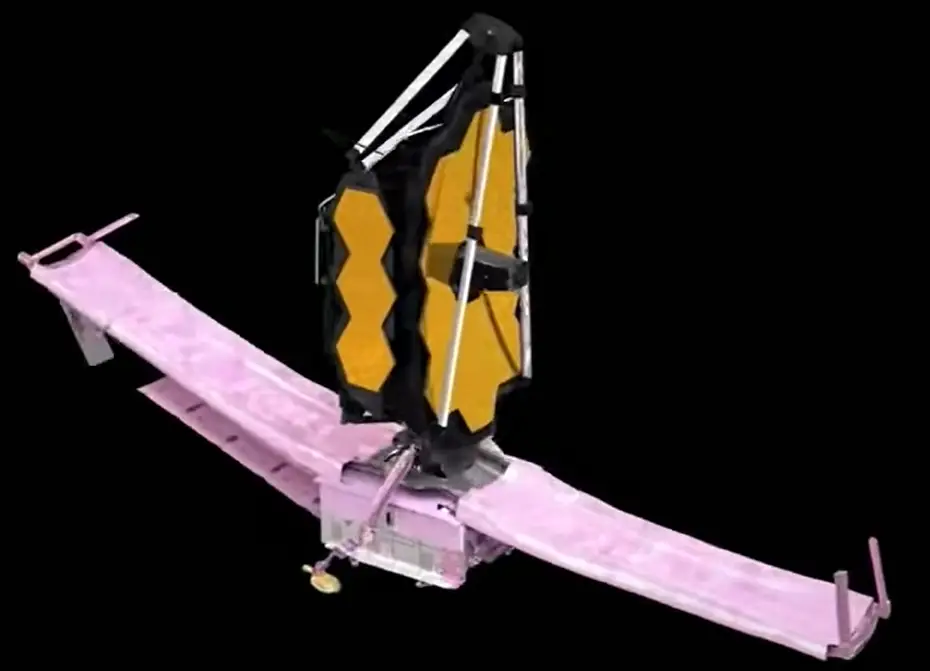
The James Webb Space Telescope (JWST) adds an important dimension to this study by imaging in the near-infrared. A recent preprint reports new JWST + NIRCam images of M87’s jet at wavelengths of 0.9, 1.5, 2.77 and 3.56 µm. arXiv Through careful modeling and subtraction of the galaxy’s smooth brightness, the jet structure is isolated and studied.
These infrared observations confirm that the jet largely follows a synchrotron power-law spectrum (flux ∝ wavelength^α, with α between 0.7–1.0) consistent with similar behavior in radio and optical bands. arXiv The images also resolve individual knots—regions of enhanced emission along the jet flow, such as “HST-1,” which shows a double-component structure. arXiv Furthermore, a faint “counter-jet” component (the forward jet head might obscure the counterpart) has been observed ~24 arcseconds from the core. arXiv
These multiwavelength images help trace how energy is launched, collimated, and evolves along the jet over different scales and wavelengths.
Broader Context & Theoretical Challenges
The new results contribute to a growing body of knowledge about how black holes “feed” and “feedback.” In particular, M87 is considered a prime cosmic laboratory for studying accretion-ejection coupling: how infalling matter forms disks, magnetic fields, and then propels part of that matter outward as jets across vast distances. arXiv+3arXiv+3arXiv+3
Observations at multiple frequencies—from radio to infrared to even gamma rays—are crucial. The challenge lies in connecting the small (event horizon) scales to the large (kiloparsec jet lobes) scales, while accounting for absorption, relativistic beaming, magnetic interactions, and plasma physics. arXiv+2arXiv+2
For instance, some recent studies find that the apparent size of the ring at certain wavelengths is larger than expected from the pure gravitationally lensed photon ring model, indicating additional contributions from accretion flow and absorption. arXiv+1 Also, the jet’s collimation remains surprisingly tight over enormous distances, raising questions about how magnetic fields and plasma instabilities stabilize the flow. arXiv+1
Moreover, simulations and analytic models must now contend with more precise imaging constraints: how strong are the magnetic fields near the jet base? What fraction of the inflowing matter actually goes into the jet? How does spin of the black hole influence jet power? The new images provide sharper observational “input data” to test these theories.
Implications & Future Prospects
These observations mark a significant turnaround: black holes, once deemed invisible, are now being probed in ever more detailed ways. The conjunction of radio interferometry (especially VLBI networks like EHT) and infrared telescopes like JWST is proving to be a powerful synergy.
Looking ahead, repeated and simultaneous multiwavelength observations will be vital. By observing how the jet’s brightness, polarization, and morphology evolve over time, astronomers can infer magnetic field dynamics, shock fronts, particle acceleration zones, and even transient flares.
The success with M87 also bodes well for studying black holes in other active galaxies, including our own Milky Way’s central black hole, Sagittarius A*. Already, recent EHT polarization work has revealed strong magnetic field structure around Sgr A*, and it shares surprising similarities with M87* despite their huge mass difference. Space
In conclusion, the “clearest ever” images of M87’s black hole and jet (using both radio and JWST infrared data) bring us closer than ever to understanding the intimate physics of the cosmic engines powering active galaxies. This work builds upon earlier breakthroughs (like the first black hole image by EHT) and now blazes a path toward truly dynamic, multiwavelength “movies” of black holes in action.
Acknowledgments & Sources
This article is based on aggregated reporting from Space.com (including the piece you linked), ScienceDaily, and additional peer-reviewed and preprint research (e.g. arXiv) on the JWST infrared jet observations of M87 (Röder et al. 2025) and related theoretical/observational reviews (e.g. on accretion and jet mechanics).