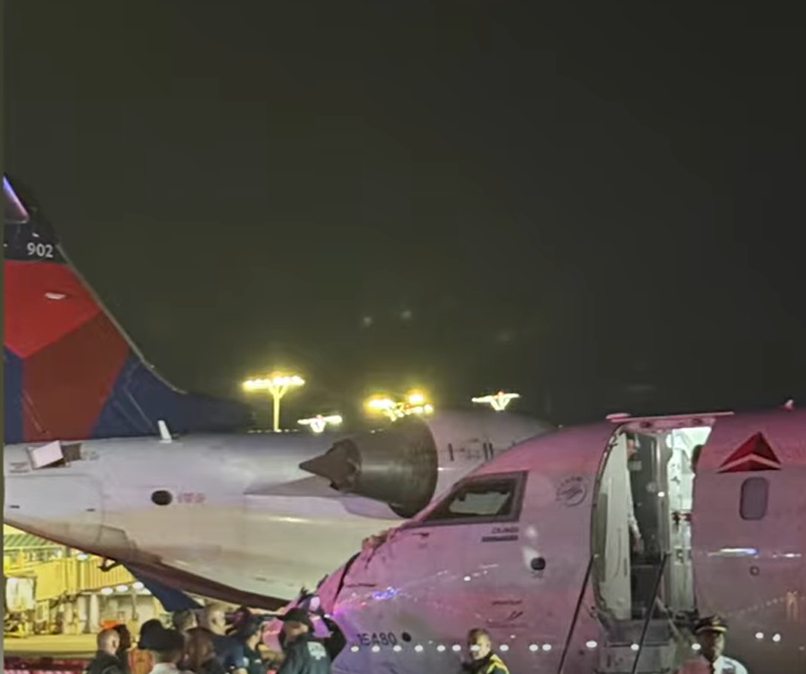
On the evening of October 1, 2025, two Delta Air Lines regional jets collided at LaGuardia Airport in New York while taxiing. Though this was a low-speed ground incident, the impact was significant — part of the wing of one aircraft detached, and a flight attendant sustained a minor injury. Thankfully, no passengers were harmed. People.com+2AP News+2
This event has drawn attention to a critical, though less-discussed, phase of air travel: ground operations. While takeoffs and landings receive much of the scrutiny, collisions during taxiing remain a danger as airports grow busier.
Below is a comprehensive look at what we know so far, the risks involved, possible causes, and what this incident means for aviation safety.
What Happened: Facts
- The two aircraft involved were CRJ-900 regional jets operated by Endeavor Air, a Delta Connection carrier. People.com
- The collision occurred shortly before 10:00 p.m. local time as one plane was arriving from Charlotte, North Carolina (Flight 5047), and the other was preparing to depart for Roanoke, Virginia (Flight 5155). People.com+1
- The right wing of the departing jet clipped the nose and cockpit area of the arriving aircraft. People.com+1
- Damage included a shattered windshield, a gouged fuselage nose, and a detached wing section. AP News+1
- One flight attendant was injured (knee injury) and hospitalized; no passengers were hurt. People.com+2AP News+2
- Airport operations were not disrupted, and passengers were bused to terminals and accommodated overnight. People.com+1
- According to Air Traffic Control (ATC) audio recorded on LiveATC, the pilot of one aircraft stated, “We have two CRJs on [taxiway] M that collided… their right wing clipped our nose and the cockpit wind screens.” People.com
Given that the collision happened on the ground rather than during flight, the incident may not command headlines as dramatic as mid-air crashes, but it is nonetheless a serious safety lapse.
Why Taxiway Collisions Matter
At first glance, a “low-speed” collision might seem benign compared to airborne disasters. But the truth is taxiway incidents carry considerable risks:
- Structural Damage
Even at slower speeds, the force can damage critical parts like wings, fuselage, landing gear, and control surfaces. Repairing such damage is costly and time-consuming. - Injury Risk
Crew members and ground personnel are exposed to danger when parts detach or strike surfaces. In this case, a flight attendant suffered a knee injury. - Operational Disruption
Ground collisions can lead to runway/taxiway closures, flight delays, and domino effects throughout busy airport systems. - Safety Oversight Gaps
Such incidents may reveal weaknesses in ground traffic control, communication protocols, or situational awareness in congested airport environments. - Public Confidence
Even an incident with no fatalities shakes public trust in airline safety procedures.
Hence, investigating and learning from these events is crucial.
Possible Contributing Factors
Though the investigation is ongoing, several factors typically contribute to taxiway collisions:
1. Pilot or Crew Miscommunication
Ground operations require flawless coordination between pilots, ground control, and ATC. Misheard instructions or assumptions about right-of-way can result in collisions.
2. Complex Taxiway Layouts and Congestion
Busy airports like LaGuardia have intricate taxiway networks. In low-visibility or nighttime conditions, crew may misinterpret taxi paths or crossholds.
3. Reduced Lighting or Visibility
After dark, lighting conditions, glare, or suppression of landing lights to preserve night vision can hamper visual awareness. AP News+1
4. Pilot Inattention or Fatigue
Fatigue or distraction can degrade situational awareness—especially in repetitive taxi operations at night.
5. ATC Instructions or Clearance Errors
Controllers may inadvertently clear one aircraft into conflict or fail to ensure proper spacing, leading to collisions.
6. Equipment or Marking Issues
Defective taxiway signage, lighting, or pavement markings can mislead pilots. And if ground radar or surface surveillance systems malfunction, detection of conflicts may be delayed.
Given the available information, some experts suggest that both controllers and pilots share responsibility for maintaining awareness during complex ground movement. AP News
What Happens Next: Investigation & Responses
Delta Air Lines has pledged full cooperation with regulatory authorities, including the FAA and the National Transportation Safety Board (NTSB). People.com+1 The FAA is expected to study ATC audio, surveillance footage, ground radar logs, and pilot communications to pinpoint the root cause.
Investigators will examine:
- Taxiway clearance procedures
- Crew communications and decision-making
- ATC instructions and timing
- Lighting, signage, and taxiway layout at the time
- Aircraft positioning and speed
- Maintenance and inspection records for both aircraft
Once the investigation concludes, recommendations may follow to improve ground safety protocols, update training, or enforce stricter oversight.
Implications for Aviation Safety
This collision underscores the importance of addressing safety not just in the air but also on the ground. For policy makers, airport authorities, and airlines, several lessons emerge:
- Improve Surface Surveillance: Enhanced ground radar, cameras, and conflict detection systems can alert controllers and pilots to potential collisions early.
- Strengthen Pilot/ATC Training: Emphasis on taxiway protocols, night ops, situational awareness, and communication clarity.
- Review Taxiway Design: Airports might redesign complex junctions, reduce conflict points, or simplify routes.
- Enforce Standard Operating Procedures (SOPs): Uniform rules for right-of-way, crossing, and holding must be rigorously followed.
- Audit Lighting & Markings: Ensuring taxiway markings, signs, and lighting are visible, consistent, and maintained.
- Redundant Cross-Checks: Pilots and ATC should cross-check each other’s movements before taxiing through sensitive intersections.
Incremental improvements in these areas can make taxiing safer and reduce ground collision risk.
Broader Context: Ground Safety Incidents Aren’t New
While headline-grabbing mid-air crashes dominate news coverage, ground incidents are far more common than many realize. For instance, in 2024, a Delta A350 struck a CRJ-900 at Atlanta’s taxiways during a ground maneuver. The Guardian Although damaging, it did not lead to injuries. These events point to the consistent vulnerability of ground operations, especially amid increasing air traffic volume and tighter scheduling pressures.
What This Means for Passengers and Aviation Observers
For fliers, this incident serves as a reminder that safety extends beyond takeoff and landing. When you’re taxiing to the gate or runway, the aircraft is still in motion, and protocols remain in effect.
Airline operators and regulators must treat ground operations as equally high-risk zones. Investments in technology, training, and procedures are just as relevant here.
Finally, this collision is a valuable case study for the aviation community—a chance to learn and reinforce standards at the intersection of human judgment, machine guidance, and tightly orchestrated systems.
The collision of two Delta regional jets at LaGuardia while taxiing might not make headlines like a dramatic crash, but its lessons are profound. An aircraft’s ground movement is just as critical to safety as its time in the air. This incident reminds us that multiple layers of vigilance — pilot discipline, ATC precision, infrastructure reliability, and technology support — must work in tandem to prevent even “low-speed” accidents.
As investigations continue, we hope that the industry applies the lessons learned here to ensure ground collisions become rarer and safer skies — and runways — remain the priority.
References
- Times of India. “Two Delta planes collide while taxiing at LaGuardia Airport in New York; wing of one plane detached”
- People Magazine. “2 Delta Jets Collide on the Taxiway at New York’s LaGuardia Airport, Leaving a Member of Cabin Crew Injured” People.com
- AP News. “Two Delta jets damaged in ‘low-speed collision’ on LaGuardia taxiway, injuring 1” AP News
- Fox5NY. “2 planes collide while taxiing at LaGuardia Airport; flight attendant injured” FOX 5 New York
- Business Insider. “2 planes collide while taxiing at LaGuardia Airport” Business Insider
- WSJ. “Delta Jets Collide While Taxiing at LaGuardia Airport” The Wall Street Journal
Recent Related News
Two Delta jets damaged in ‘low-speed collision’ on LaGuardia taxiway, injuring 1
:max_bytes(150000):strip_icc():format(jpeg)/delta-collision-100225-1-abc5b3ce7d424d01bfd597eae0aa6f69.jpg)
2 Delta planes collided while taxiing on the runway at LaGuardia