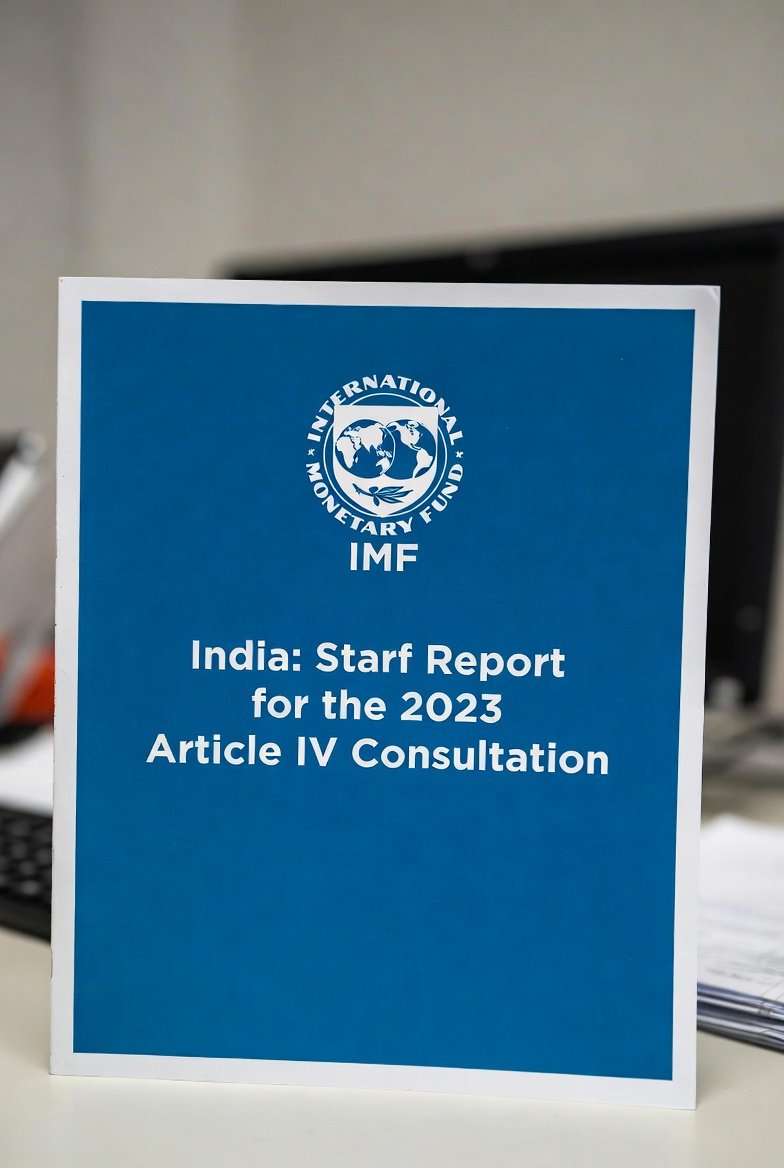
The IMF Report on India for 2025 has raised significant concerns regarding the quality and reliability of India’s GDP and national accounts statistics. According to recent evaluations, the International Monetary Fund (IMF) has assigned India a “C-grade”, the second-lowest rating, for the credibility and consistency of its macroeconomic data. This rating highlights certain methodological gaps that may affect economic assessments and policy-making.
Why Did the IMF Give India a C-Grade?
1. Outdated Base Year for GDP Calculation
India still uses 2011–12 as the base year for calculating GDP, despite major changes in consumption patterns, digital transactions, and economic structure. The IMF states that not updating the base year weakens the accuracy of real GDP figures and overall economic measurement.
2. Excessive Reliance on WPI-Based Deflators
The IMF Report on India highlights India’s dependence on the Wholesale Price Index (WPI) to deflate nominal GDP. The services sector — which forms over 50% of the economy — is not adequately captured through WPI, causing distortions in real GDP numbers.
3. Discrepancies Between Production and Expenditure Estimates
India’s GDP is measured using both GVA (production-side) and expenditure-side methods. The IMF notes that large inconsistencies exist between these two approaches, indicating possible data gaps or statistical inefficiencies.
4. Limited Coverage of the Informal Sector
India’s informal economy is vast, but its measurement depends on outdated surveys. The IMF Report on India mentions that missing or infrequent surveys fail to capture small enterprises, unorganized labor, and household economic activities accurately.
5. Slow Data Updates and Revisions
Many datasets such as household consumption surveys, employment surveys, and enterprise surveys have not been updated regularly. This affects policymaking, investment strategies, and macroeconomic credibility.
Government Response and Planned Reforms
The Government of India, through MoSPI, has initiated several corrective measures:
- Proposing a new GDP base year (likely 2022–23)
- Using GSTN, MCA-21, and digital transaction data for better GDP estimation
- Updating CPI, IIP, and deflation methods
- Conducting more frequent consumption and enterprise surveys
If implemented effectively, these reforms can significantly improve India’s statistical credibility.
Implications for the Economy and Policy
A C-grade does not imply India’s economy is weak, but that data quality needs improvement.
This rating affects:
- Investor confidence
- Global ratings
- Policy accuracy (monetary and fiscal)
- Academic and institutional research
Reliable data is essential for building long-term economic trust.
1. IMF Report on India: 7 Powerful Insights Highlight Strong Progress but Warn of Serious Data Weaknesses
(Positive: Strong Progress | Negative: Serious Weaknesses)
2. IMF Report on India: Impressive Economic Growth Yet Troubling C Grade on GDP Data — Full Breakdown
(Positive: Impressive | Negative: Troubling)
3. IMF Report on India: 5 Remarkable Improvements and Alarming Gaps in GDP & National Accounts Data
(Positive: Remarkable | Negative: Alarming)
4. IMF Report on India: Encouraging Trends but Critical Issues Behind the C Grade Explained
(Positive: Encouraging | Negative: Critical Issues)
5. IMF Report on India: Strong Economic Momentum vs. Concerning Data Quality — What the C Grade Means
Impact on Employment
The IMF Report on India also indicates that unreliable GDP and national accounts data can affect employment planning and labor market policies. When employment surveys, informal sector estimates, and enterprise-level data are outdated, the government may misjudge the real employment situation—whether job creation is rising, stagnating, or declining. This can lead to underestimation of informal jobs, incorrect allocation of skill-development resources, and poor forecasting of future labor demand. Inaccurate data also affects private companies and investors who rely on employment indicators to plan expansions. Therefore, improving statistical systems is essential to understand true job growth and workforce needs.
The IMF Report on India serves as a reminder that while economic growth matters, transparent and updated data systems are equally important. With planned reforms, India has the opportunity to strengthen its statistical foundation and improve global confidence.
IMF gives India a ‘C’ on its GDP and other national …

Explainer: Making sense of India’s 8.2% growth – and IMF’s ‘C’ on GDP data
- https://theearthcurrent.com/category/earth-climate-change/
- https://theearthcurrent.com/category/science-and-space/
- https://theearthcurrent.com/category/world-affairs/
- https://theearthcurrent.com/category/sports/
- https://theearthcurrent.com/category/entertainment/
- https://theearthcurrent.com/category/artificial-intelligence/