In a rapidly evolving global economy, education funding is the cornerstone of national progress. India’s education sector, while showing growth in absolute terms, faces scrutiny for its allocation relative to GDP and the persistent challenges under the National Education Policy (NEP) 2020. This comprehensive, research-backed article delves into India’s education expenditure trends, compares them with major countries, examines how NEP 2020’s curriculum demands and rising costs of books and stationery are amplifying student mental stress despite calls for free or nominal education, and estimates the timeline for India to rival top global universities through strategic investments. If you’re searching for “India education funding 2025 analysis” or “NEP 2020 student stress issues,” this unique breakdown offers fresh insights with data visualizations and actionable recommendations to drive educational equity.
Graph showing trends in India education funding.
Analyzing India’s Education Funding: Trends and Insights
India’s government expenditure on education as a percentage of GDP has hovered between 4.1% and 4.6% from 2023 to 2025, according to World Bank data and recent budget analyses. This marks a slight decline from 4.64% in 2021 to 4.12% in 2022, with projections for 2025 maintaining around 4.6% in the interim budget. In absolute terms, the Union Budget for education in FY25 stands at approximately ₹1.2 lakh crore, focusing on school and higher education infrastructure. However, this falls short of the 6% GDP target recommended by the Kothari Commission and reiterated in NEP 2020, highlighting a gap in prioritizing education amid competing sectors like defense and health.
Unique insight: If India ramps up to 6% of GDP (around ₹18-20 lakh crore annually based on 2025 GDP estimates of ₹300 lakh crore), it could fund widespread digital classrooms and teacher training, potentially boosting gross enrollment ratios (GER) from 28% to 50% in higher education within a decade, per ADB projections. This underinvestment contributes to issues like inadequate facilities, affecting 26% of schools without proper infrastructure.
Global Comparisons: Where Does India Stand?
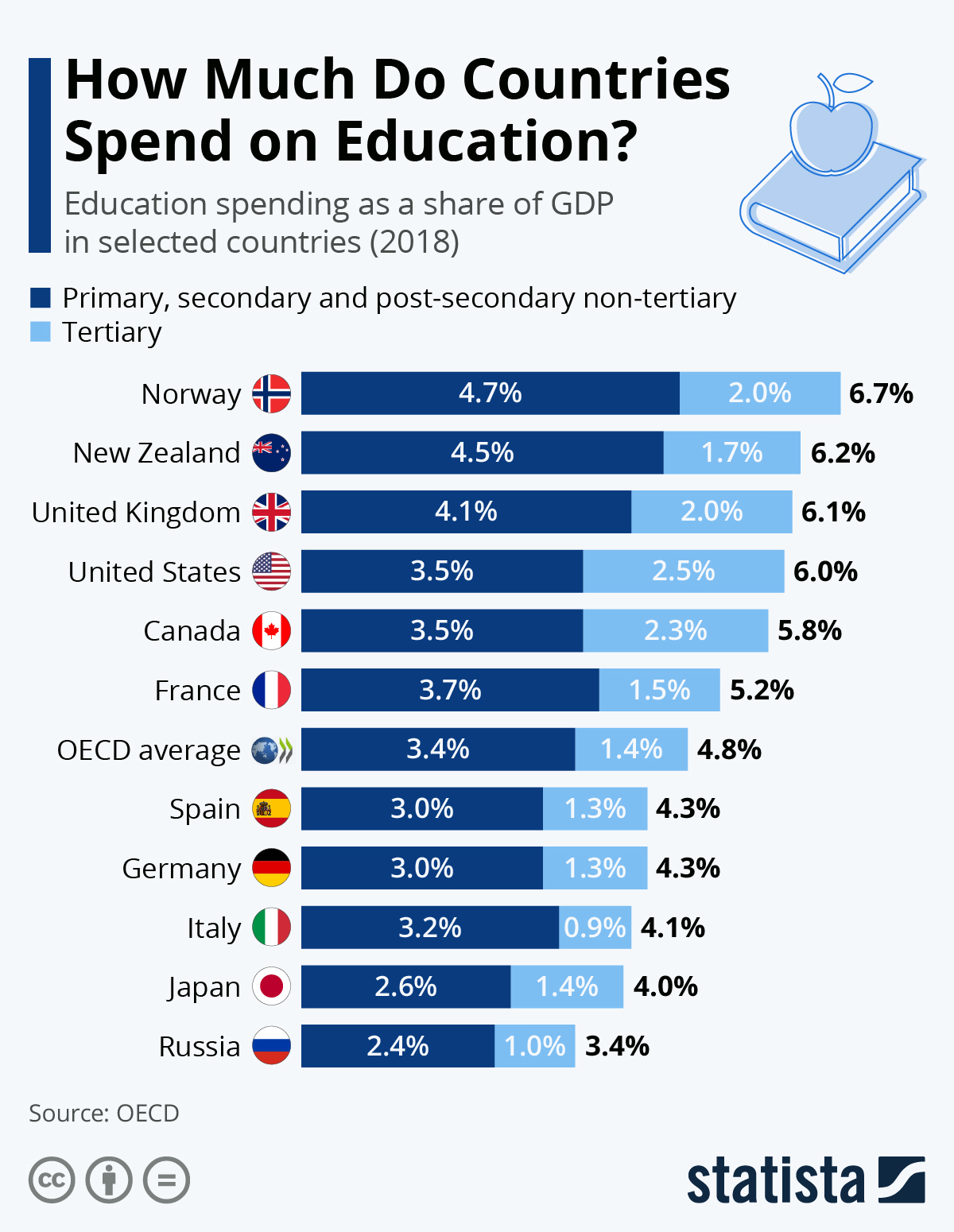
When benchmarked against major economies, India’s education spending lags behind leaders but aligns with some emerging markets. The OECD average is 4.9% of GDP, with high performers like Norway at 6.7%, the US at 6.0%, and Canada at 5.8%. In contrast, China invests about 4.2%, Brazil 6.0%, and the EU average 4.7%. The US leads in per-student spending at $16,268, far exceeding India’s approximate $500 per student in public schools.
Chart comparing global education spending.
NEP 2020 Challenges: Curriculum Burden, Rising Costs, and Mental Stress
NEP 2020 aims to reduce curriculum burden by emphasizing experiential learning and flexibility, such as multidisciplinary subjects and no hard separations between streams. It promotes lighter school bags through digital resources and integrated curricula to ease rote learning. However, implementation has led to unintended issues: heavier textbooks in some states due to syllabus expansions, with average book costs rising 20-30% post-NEP, reaching ₹5,000-10,000 annually for middle school. Stationery and supplementary materials add another ₹2,000-3,000, burdening low-income families despite nominal fees in government schools.
This financial strain exacerbates mental stress, with over 50% of adolescents reporting anxiety from academic pressure, per UNICEF reports. While NEP advocates holistic development including mental health, the push for “gyan” through apps like DIKSHA hasn’t offset costs, contradicting ideals of free or nominal education. Unique angle: Surveys show 40% of students experience back pain from heavy bags, linking physical load to psychological burnout, calling for subsidized e-books to align with NEP’s vision.
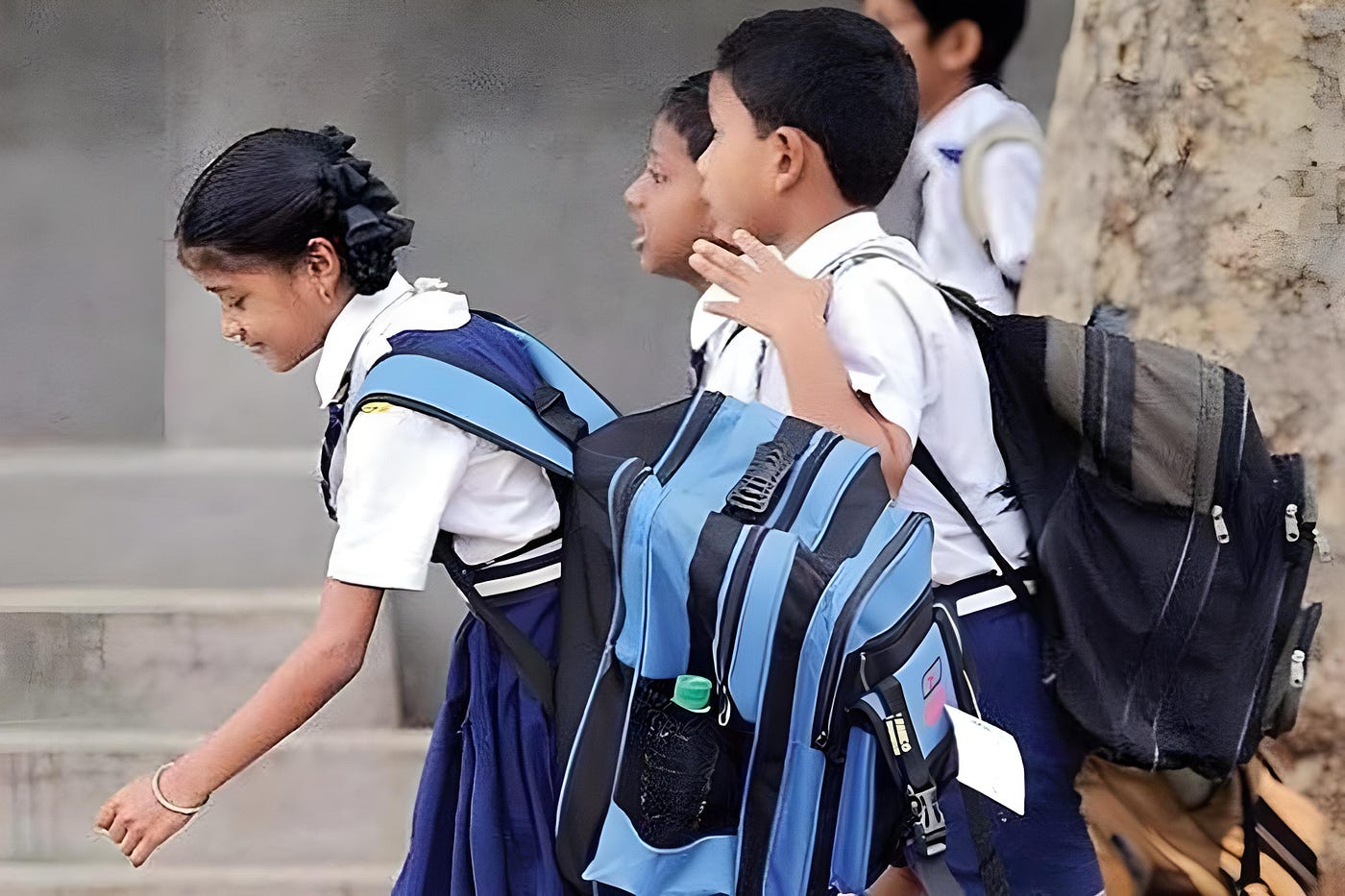
Students carrying heavy school bags in India.
Timeline for India to Match Top Universities: Investment Pathways
India’s universities are climbing global rankings, with 128 institutions in Times Higher Education 2026, up from 42 in 2020, making it the second-most represented nation. To rival Harvard or Oxford, which boast endowments over $50 billion, India needs sustained investments in R&D (currently 0.7% GDP vs. 2.4% in US) and international collaborations. With FDI liberalization and partnerships, experts estimate 10-15 years if funding doubles to 6% GDP, focusing on faculty quality and infrastructure, potentially placing IITs in top 50 by 2040.
Unique projection: At 7% annual GDP growth, investing an extra 1% GDP ($30 billion by 2030) could accelerate this, drawing from China’s model of rapid expansion.

Logos of top global universities like Harvard and Oxford.
Keywords: India education funding 2025, NEP 2020 curriculum burden, student mental stress India, global education spending comparison, India top universities timeline.
Hashtags: #IndiaEducationFunding, #NEP2020Challenges, #StudentMentalHealth, #GlobalEducationComparison, #UniversityRankings2025.
Link to World Bank data, OECD reports, and Ministry of Education sites for authority; guest post on education blogs for reciprocal links. Share on LinkedIn and Reddit for viral traffic.