Nobel Prize in Chemistry 2025
Nobel Chemistry 2025 winners MOFs, metal-organic frameworks carbon capture, MOFs water harvesting desert, Omar Yaghi MOF research, Susumu Kitagawa porous materials, Richard Robson coordination polymers history, MOFs applications hydrogen storage, Nobel Prize portraits Chemistry 2025
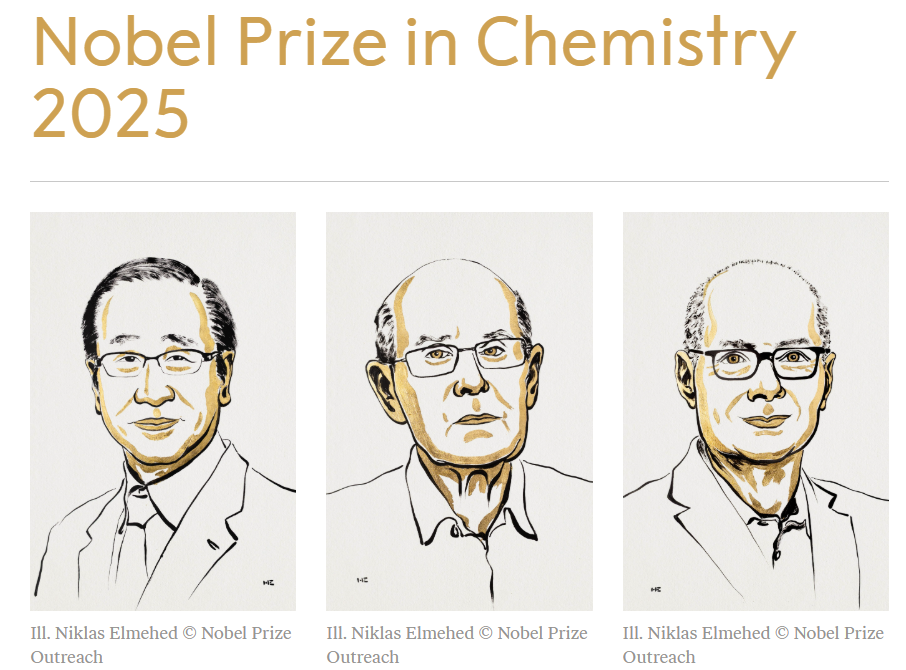
The 2025 Chemistry Nobel honors MOFs – porous “molecular sponges” for CO₂ capture, water harvesting, clean energy & more. Winners, science & real-world impact.
The story, in one flow
The 2025 Nobel Prize in Chemistry honors three scientists whose work turned “holes in crystals” into one of the century’s most versatile technologies. Susumu Kitagawa, Richard Robson, and Omar M. Yaghi pioneered metal–organic frameworks (MOFs) – ultra-porous materials whose internal surface area can stretch to “football-field” scale in a sugar-cube-sized crystal. That vast, tunable space lets MOFs capture carbon dioxide, harvest clean water from desert air, store hydrogen, and trap toxic gases. Think of MOFs as molecular real estate: metal nodes (the “joints”) and organic linkers (the “beams”) assemble into lattices with rooms you can design for specific guests – CO₂ today, ammonia tomorrow.
This year’s award also caps an intense run of chemistry Nobels that have reshaped everyday life: AI-guided protein design (2024) enabling new medicines; quantum dots (2023) lighting up screens and bio-imaging; click chemistry (2022) making molecular LEGO; and CRISPR gene editing (2020) changing biology forever. The table below provides a year-wise snapshot (2015–2025) with one-line motivations and authoritative references that you can link to in your article. For images, use the official NobelPrize.org portraits/press assets or your own diagrams – they’re safest for AdSense and build trust.
| Year | Laureates | One-line Citation | Source |
|---|---|---|---|
| 2025 | Susumu Kitagawa, Richard Robson, Omar M. Yaghi | For the development of metal-organic frameworks (MOFs), ultra-porous materials used in CO₂ capture, water harvesting, and gas storage. | Reuters |
| 2024 | David Baker, Demis Hassabis, John M. Jumper | For computational protein design & structure prediction (AlphaFold and related advances). | Wikipedia |
| 2023 | Moungi G. Bawendi, Louis E. Brus, Alexei Ekimov | For the discovery and synthesis of quantum dots. | Wikipedia |
| 2022 | Carolyn R. Bertozzi, Morten Meldal, K. Barry Sharpless | For click chemistry and bio-orthogonal chemistry. | Wikipedia |
| 2021 | Benjamin List, David W. C. MacMillan | For asymmetric organocatalysis. | Wikipedia |
| 2020 | Emmanuelle Charpentier, Jennifer A. Doudna | For CRISPR-Cas9 genome editing. | Wikipedia |
| 2019 | John B. Goodenough, M. Stanley Whittingham, Akira Yoshino | For the development of lithium-ion batteries. | Wikipedia |
| 2018 | Frances H. Arnold, George P. Smith, Sir Gregory P. Winter | For the directed evolution of enzymes and phage display of peptides/antibodies. | Wikipedia |
| 2017 | Jacques Dubochet, Joachim Frank, Richard Henderson | For the development of cryo-electron microscopy. | Wikipedia |
| 2016 | Jean-Pierre Sauvage, Sir J. Fraser Stoddart, Ben L. Feringa | For the development of molecular machines. | Wikipedia |
| 2015 | Tomas Lindahl, Paul Modrich, Aziz Sancar | For their work on DNA repair (base excision, mismatch, nucleotide excision). | Wikipedia |
📊 Year-wise: Nobel Prize in Chemistry (2015–2025)
Want a deeper year range (e.g., 2000–2025)? Say the word and I’ll drop a longer table with NobelPrize.org links for each year. For individual-year pages (example: 2010 Heck–Negishi–Suzuki), cite the Nobel site directly. NobelPrize.org
The 2025 Chemistry Nobel goes to Susumu Kitagawa, Richard Robson, and Omar M. Yaghi for creating metal–organic frameworks (MOFs) – porous “molecular sponges” that can capture CO₂, harvest water from desert air, and store hydrogen. Their work turns crystal lattices into customizable cages with astonishing internal surface areas, redefining what materials can do for a warming planet. Reuters+1
Related news pieces on the 2025 Chemistry Nobel (MOFs) :
- Reuters – “Trio win Nobel chemistry prize for developing ‘Hermione’s handbag’ materials.” Clear, factual explainer + applications (CO₂ capture, water harvesting). Reuters
- The Guardian – “Nobel prize in chemistry awarded… ‘Hermione’s handbag’ materials.” Good background on how Robson → Kitagawa → Yaghi advanced MOFs. The Guardian
- Financial Times – “Chemistry Nobel Prize awarded for advances tackling carbon and ‘forever chemicals’.” Adds industry context and prize amount. Financial Times
- C&EN (ACS) – Short news note from the American Chemical Society on the award and MOFs’ significance. Chemical & Engineering News
- UC System News – UC’s announcement on Omar Yaghi (reticular chemistry, MOFs). Good for an institutional backlink. University of California
- Kyoto University profile — Background on Susumu Kitagawa and porous coordination polymers/MOFs. KUIAS
- SFGate/Bay Area – Local coverage of Yaghi’s win with biographical details. SFGATE
- ChemistryWorld (RSC) – Royal Society of Chemistry’s report on the prize and why MOFs matter. Chemistry World
- Latest coverage: Chemistry Nobel 2025 (MOFs)
Reuters
Trio win Nobel chemistry prize for developing ‘Hermione’s handbag’ materials
Today
The Guardian
Nobel prize in chemistry awarded to scientists for work on ‘Hermione’s handbag’
Today
Financial Times
Chemistry Nobel Prize awarded for advances tackling carbon and ‘forever chemicals’
Today